How Long to Smoke Baby Back Ribs at 225°F?
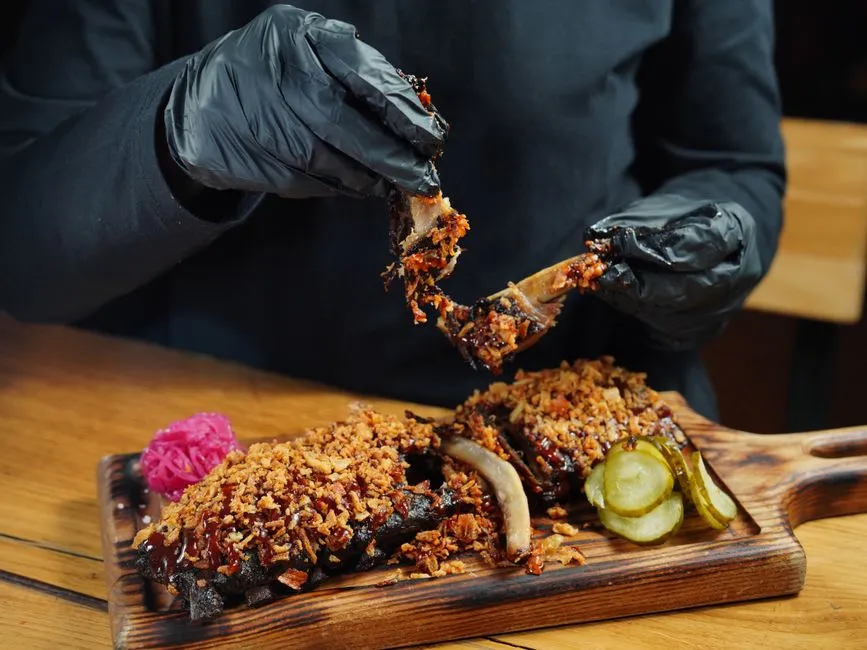
- How long do baby back ribs take at 225°F?
- Which five-hour method does this describe?
- What should the first two hours establish?
- Why can the second stage run longer?
- How do you check safety without confusing it with tenderness?
- How can you plan backward from dinner?
- What needs to stay safe throughout the afternoon?
- Frequently asked questions
- Sources
How long do baby back ribs take at 225°F?
Allow about five hours of cooking for the specific Traeger Kitchen method outlined below, not for every rack or smoker. Its temperature and tenderness checks override the clock. Verify pork reaches at least 145°F with a food thermometer and rests at least three minutes; barbecue tenderness is separate. Use fuel-burning smokers only outdoors under their manuals and local fire rules, away from openings and combustibles, because of carbon-monoxide and fire hazards.
This is a desk-researched timing guide, not a recipe we cooked or tested. It explains one published method and adds an original planning worksheet.
Which five-hour method does this describe?
Traeger Kitchen's baby back recipe specifies three racks weighing 2–2½ pounds each, kosher salt and black pepper to taste, and hickory pellets. It stays at 225°F without a wrapping stage. Read its complete preparation and equipment directions before cooking.
| Stage | Published timing and endpoint |
|---|---|
| Preheat | 15 minutes at 225°F with the lid closed |
| First stage | Meat-side up; about 2 hours, with 160°F as the internal-temperature transition |
| Second stage | Flip meat-side down; about 3 hours more |
| Finish | 203–205°F internally and very little probe resistance |
These recipe details were checked September 8, 2026. The temperature range in the final row is that recipe's tenderness target, not a universal pork safety requirement. Do not replace either its temperature or probe check with “five hours have passed.”
The recipe's Super Smoke instruction applies only where available. Do not improvise a substitute or modify a cooker.
What should the first two hours establish?
Start the cooking clock when the prepared ribs enter the preheated smoker. Do not include shopping, refrigerator thawing, seasoning or preheating in the five-hour cooking estimate.
USDA smoking guidance calls for fully thawed meat and separate monitoring of smoker air and food temperatures. It specifies keeping smoker heat between 225°F and 300°F throughout cooking. For this selected recipe, the target remains 225°F; the USDA range is not permission to change the method's setpoint arbitrarily.
Follow the equipment manual for probe placement and adjustments. Record actual readings, not just the controller setting. Our clean-smoke guide addresses combustion separately.
During this first stage, your notes should answer: when did the ribs go on, what is the cooker reading, and what does the meat thermometer show? Do not invent an hourly internal-temperature progression. A starting and ending value cannot tell you what every rack should read halfway between them.
Why can the second stage run longer?
USDA identifies meat size and shape, distance from the heat, coal temperature and weather as cooking-time variables. A five-hour estimate cannot account for every combination.
Treat a late transition as new scheduling information. If the first stage takes longer than planned, do not subtract that delay from the remaining cooking merely to preserve dinner time. Conversely, do not keep a finished rack cooking only because another rack needs longer.
Write an individual record for each rack: identifier, package weight, transition time, final temperature reading, tenderness result and removal time. This is a practical record, not a laboratory comparison.
If you intend to wrap, change the temperature or use a different cut, choose a complete method written for those decisions. Do not attach an unrelated wrapped stage to this unwrapped schedule. The 225°F versus 250°F guide explains the broader choice; the 250°F baby back recipe is a separate method, not a fixed time-saving conversion.
How do you check safety without confusing it with tenderness?
The federal safe-temperature chart specifies 145°F plus a three-minute rest for pork steaks, roasts and chops. This guide uses that whole-pork minimum as the safety floor, while retaining the selected rib recipe's separate finish criteria.
Use a suitable food thermometer in the thickest meat, avoiding bone, fat and gristle. FoodSafety.gov explains correct placement. Check each rack rather than assuming one represents all three. Color, exposed bone and the timer do not replace temperature verification.
Reaching the safety floor does not establish the texture specified by this recipe. Equally, an apparently tender rack does not excuse an unreliable reading. Keep the two decisions separate in the log.
How can you plan backward from dinner?
Here is an illustrative scheduling calculation, not a tested cook or safe holding allowance:
- Desired meal: 6:00 p.m.
- Selected recipe's nominal cooking estimate: 5 hours.
- Editorial uncertainty margin: 45 minutes.
- Editorial rest and serving allowance: 15 minutes.
- Planned loading time: 6:00 p.m. − 5:00 − 0:45 − 0:15 = noon.
Preheating and preparation happen before noon. The serving allowance includes the minimum three-minute pork rest; it is not a claim that the manufacturer requires a fifteen-minute rest.
If cooking ends at the nominal 5:00 p.m., do not leave ribs on the counter until dinner. Keep cooked food at 140°F or above using suitable holding equipment and verify it with a thermometer, or refrigerate promptly. The extra calendar space is flexibility, not permission for uncontrolled holding.
If the ribs are late, change the meal timing or serve a different prepared dish. A schedule cannot authorize serving undercooked food, leaving the cooker unattended or bypassing safety controls.
What needs to stay safe throughout the afternoon?
Keep raw pork refrigerated and separate from cooked food. Use clean serving utensils and plates; do not reuse a raw-meat utensil without washing it. These are FDA barbecue precautions, not optional finishing details.
The U.S. Fire Administration says propane, charcoal and wood-pellet grills belong outside and must not be left unattended while lit. Follow manufacturer clearances, fuel and shutdown instructions and current local restrictions. Do not move the smoker into a garage or carport because weather changes; CDC warns against those locations and placement near building openings.
For suspected carbon-monoxide poisoning, get outside to fresh air immediately and call 911, as CPSC directs.
Frequently asked questions
Are five hours at 225°F guaranteed to finish baby back ribs?
No. Five hours is the selected manufacturer's estimate, not a universal deadline. Follow that recipe's staged temperature and tenderness criteria. Independently verify at least 145°F and a three-minute rest for pork safety. Maintain safe outdoor cooker operation; an elapsed time cannot compensate for incorrect temperatures or interrupted cooking.
Should I flip the ribs at exactly two hours?
Treat the published first-stage time as an estimate and use its internal-temperature transition. Record when the rack actually reaches that stage rather than forcing every rack onto an identical clock. Handle hot food with suitable tools according to the cooker instructions, and keep raw-contact utensils separate from clean serving utensils.
Can I start with frozen ribs to save preparation time?
No. USDA smoking guidance requires meat to be completely thawed before smoking because slow thawing in the smoker can leave it at unsafe temperatures. Plan refrigerator thawing before the cooking day as needed, keep raw pork cold, and do not count thawing as part of a smoking recipe's cooking estimate.
Is the schedule margin a safe holding period?
No. It is an editorial planning allowance, not a food-safety window. If ribs finish early, hold them at 140°F or above with suitable equipment and temperature verification, or refrigerate promptly. Do not use a counter, unmonitored cooler or switched-off smoker as an assumed safe holding system.
How should leftover smoked ribs be stored and reheated?
Refrigerate promptly in shallow containers at 40°F or below, within two hours, or one hour if exposed to temperatures above 90°F. Properly refrigerated cooked meat keeps three to four days. Reheat leftovers to 165°F, verified with a food thermometer. Discard food left out beyond the applicable time limit.
Sources
- Traeger Kitchen: Baby Back Ribs
- USDA FSIS: Smoking Meat and Poultry
- FoodSafety.gov: Safe Minimum Internal Temperatures
- FoodSafety.gov: Four Steps to Food Safety
- FoodSafety.gov: Cold Food Storage Chart
- FDA: Barbecue Basics
- USFA: Outdoor Fire Safety
- CDC: Avoiding Carbon Monoxide Poisoning
- CPSC: Carbon Monoxide